

Production planning for the Food industry
DeepSynergy.AI supports food manufacturers whose planning is shaped by lot sizes, changeover effort, inventory and logistics – for example in spray drying and powder production. These areas are planned together rather than one after another.
Customer examples from the food industry

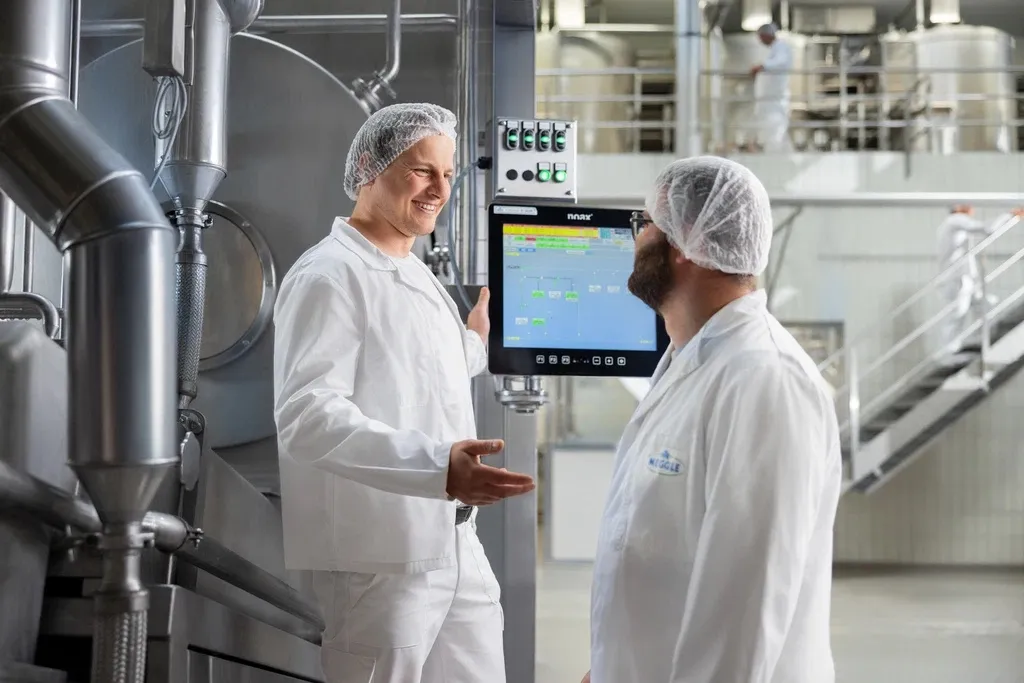 Source: https://www.meggle.com/
What makes production planning in the food industry so demanding
In food production, sequence, lot sizes, inventory and logistics are closely linked. Planning these areas one after another often optimises one at the expense of the other.
Lot sizes versus inventory
Large lots reduce changeover effort but increase inventory. Small lots add flexibility but cost equipment time.
Changeovers and cleaning
Product changes require changeovers and cleaning whose duration depends on the sequence – for example because of allergens or recipes.
Shelf life and delivery windows
Raw materials and finished goods have a limited shelf life, and customers expect fixed delivery windows. Production and delivery have to fit together.
Several stages, one bottleneck
In processes such as spray drying and powder production, one line often sets the pace for all upstream and downstream steps.
What feeds into the production plan
DeepSynergy.AI Production Planning plans sequence, lot sizes, inventory and logistics together rather than one after another. The result is a plan that balances the trade-offs between these areas.
- Orders and demand
- Customer orders, forecasts and delivery dates from the ERP.
- Lines and capabilities
- Which line can produce which products and at what output.
- Changeover and cleaning times
- How long a change from product A to product B takes, depending on the sequence.
- Raw materials and inventory
- Available raw materials, intermediate products and finished goods inventory.
- Logistics
- How production and delivery fit together in time.
- Your planning goals
- Planning effort, productivity, inventory and delivery reliability – individually weighted and balanced against each other.
Frequently asked questions about production planning in the food industry
Can planning optimise lot sizes and inventory together?
Yes. Sequence, lot sizes, inventory and logistics are considered in one shared plan. The trade-offs between these areas are balanced in a weighted system of goals.
More in the article: Planning problems and trade-offs in productionAre sequence-dependent changeover and cleaning times taken into account?
Yes. How long a change takes depends on what ran before. These times feed directly into planning so that changeovers are grouped sensibly.
How quickly do results show?
It takes 8–12 weeks from the free potential check to productive, validated planning. At MEGGLE, measurable results in spray drying and powder production were available after less than two months.
More in the article: Productive planning in 8–12 weeksWhat data does planning in food production need?
To get started, customer orders and demand, lines and their output, changeover and cleaning times, and raw material and finished goods inventory are enough. This data is usually already available in ERP, MES or Excel.
More in the article: The data you need for production planningDoes DeepSynergy.AI Production Planning replace our ERP?
No. Your ERP remains the leading system for orders, recipes and inventory. DeepSynergy.AI Production Planning takes over planning of sequence, lot sizes and logistics and returns the plan to ERP or MES.
More in the article: ERP and MES integration: a complement, not a replacementCustomer examples from other industries
Planning tasks are often similar across industries.
- ams OSRAM · Semiconductors and optoelectronics · metalworking, CNC turning and grindingProduction planning under real-world constraints
- Metal industry · laser cutting and nestingOn-time delivery and material efficiency at the laser
- NOWOFOL · Plastics industry · specialty filmsLess scrap in specialty film production
- Electrical engineering · CNC productionAutomated machine scheduling and sequencing
- Electrical engineering · metalworking, turningAssigning machines and staff in the turning shop
- Printing and paper industry · ImpregnationExperience-based knowledge as the basis for planning

What potential lies in your production planning?
In the free potential check, we talk about your production planning and assess together whether and where DeepSynergy.AI Production Planning can help.