

Production planning for the Plastics industry
DeepSynergy.AI supports plastics industry companies where changeover and cleaning times, specialised equipment and changing recipes determine the sequence – for example in specialty film production. The aim is efficient use of equipment with as little scrap as possible.
Customer examples from the plastics industry

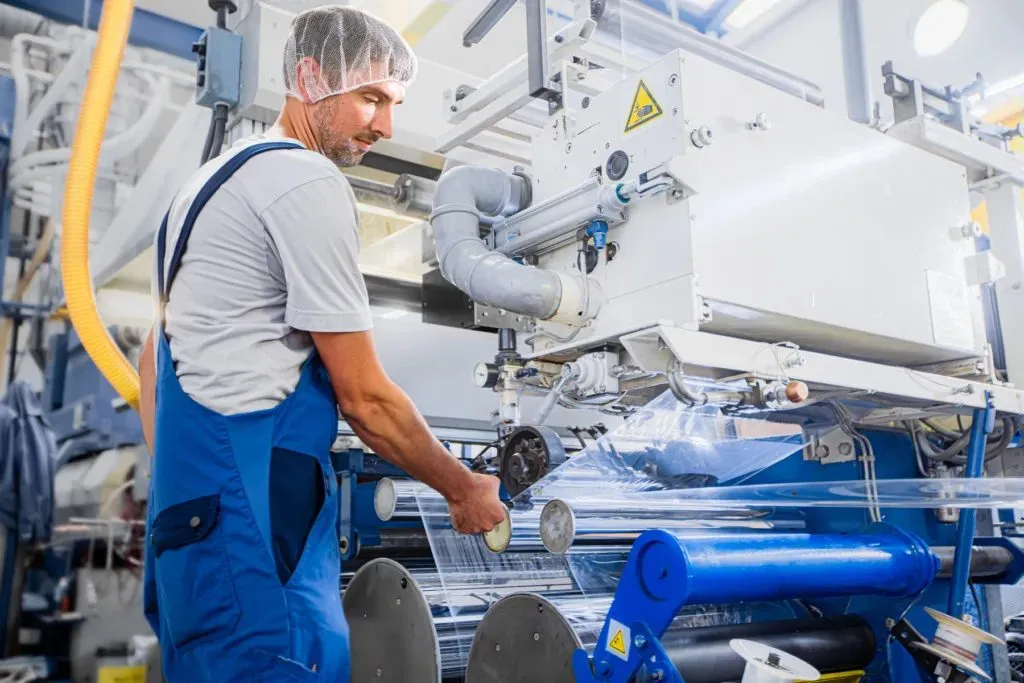 Source: https://www.nowofol.com/
What makes production planning in the plastics industry so demanding
In plastics processing, the sequence determines cost and scrap. Every changeover costs equipment time and material – and the production plan decides which changeovers occur.
Sequence-dependent changeovers
Colour, material and recipe changes take different amounts of time depending on what ran before. Running the same materials back to back saves purging and cleaning effort.
Start-up scrap
After every changeover, material is produced that cannot be sold until the process runs stably again. Fewer, better-grouped changes mean more usable output from the same raw material.
Specialised lines and tools
Widths, thicknesses, tools and the particular capabilities of individual lines determine where an order can be produced.
Large lots versus short lead times
Large lots save changeovers but increase inventory and put other orders' dates at risk. Planning weighs this trade-off afresh with every plan.
What feeds into the production plan
DeepSynergy.AI Production Planning plans sequence, lines, staff and material together rather than one after another. The result is a plan that shows which order runs on which line and when.
- Orders
- Quantities, delivery dates and priorities from ERP or Excel.
- Changeover and cleaning times
- How long a change from product A to product B takes – often known so far only to the planners.
- Lines and capabilities
- Which line can produce which products, widths or materials.
- Recipes and raw materials
- Which granulates and additives an order needs and when they are available.
- Staff and shifts
- Shift models for continuous operation and qualifications for changeovers.
- Your planning goals
- Low scrap, high delivery reliability, good line utilisation, low inventory – individually weighted and balanced against each other.
Frequently asked questions about production planning in the plastics industry
Does planning take sequence-dependent changeover and cleaning times into account?
Yes. How long a change from one product, colour or recipe to the next takes feeds directly into planning. Changeovers are grouped sensibly without losing sight of delivery dates.
More in the article: Planning problems and trade-offs in productionHow does planning help reduce scrap?
Scrap arises mainly during start-up after changeovers. A sequence with fewer, better-coordinated changes reduces this share. At NOWOFOL, planning with DeepSynergy.AI Production Planning reduced scrap in specialty film production compared with conventional planning.
Which processes is DeepSynergy.AI Production Planning suited for?
What matters is the planning task, not the process: wherever changeovers, specialised lines and recipes determine the sequence – for example in extrusion, film production, injection moulding or compounding. In the free potential check, we clarify whether it fits your production.
More in the article: Potential check and workshop: getting startedWhat data does planning in plastics processing need?
The data already used for planning today: orders with quantities and dates, lines and their capabilities, recipes, shift models and inventory. Highly detailed machine data is not required.
More in the article: The data you need for production planningDo we have to replace our ERP system?
No. DeepSynergy.AI Production Planning complements ERP and MES with a specialised planning layer. In the first project phases, data is deliberately exchanged manually or semi-automatically; the connection follows with the implementation.
More in the article: ERP and MES integration: a complement, not a replacementCustomer examples from other industries
Planning tasks are often similar across industries.
- ams OSRAM · Semiconductors and optoelectronics · metalworking, CNC turning and grindingProduction planning under real-world constraints
- Metal industry · laser cutting and nestingOn-time delivery and material efficiency at the laser
- MEGGLE · Food industry · dairy, spray drying and powder productionSpray drying and powder production in one plan
- Electrical engineering · CNC productionAutomated machine scheduling and sequencing
- Electrical engineering · metalworking, turningAssigning machines and staff in the turning shop
- Printing and paper industry · ImpregnationExperience-based knowledge as the basis for planning

What potential lies in your production planning?
In the free potential check, we talk about your production planning and assess together whether and where DeepSynergy.AI Production Planning can help.