

ams OSRAM is a leading provider of light and sensor solutions. At its Schwabmünchen site, metal pre-products are among the components manufactured and processed. In metal processing, the quality of production planning directly determines whether delivery dates are met reliably and whether human and machine resources are deployed efficiently. The challenge does not lie in individual orders, but in the interaction of raw material availability, machine allocation, shift schedules and employee qualifications.
ams OSRAM aims not only to manage this dynamic operationally, but to translate it into a robust production planning approach. To achieve this, DeepSynergy.AI maps the relevant planning logics in an automated planning system and takes into account factors such as raw material availability, setup logic, machine capabilities, as well as employee availability and qualifications. The result is a production plan that is realistic, transparent and can be adapted quickly when order conditions change.

Simon Schwarzfischer – Project Lead, ams-OSRAM

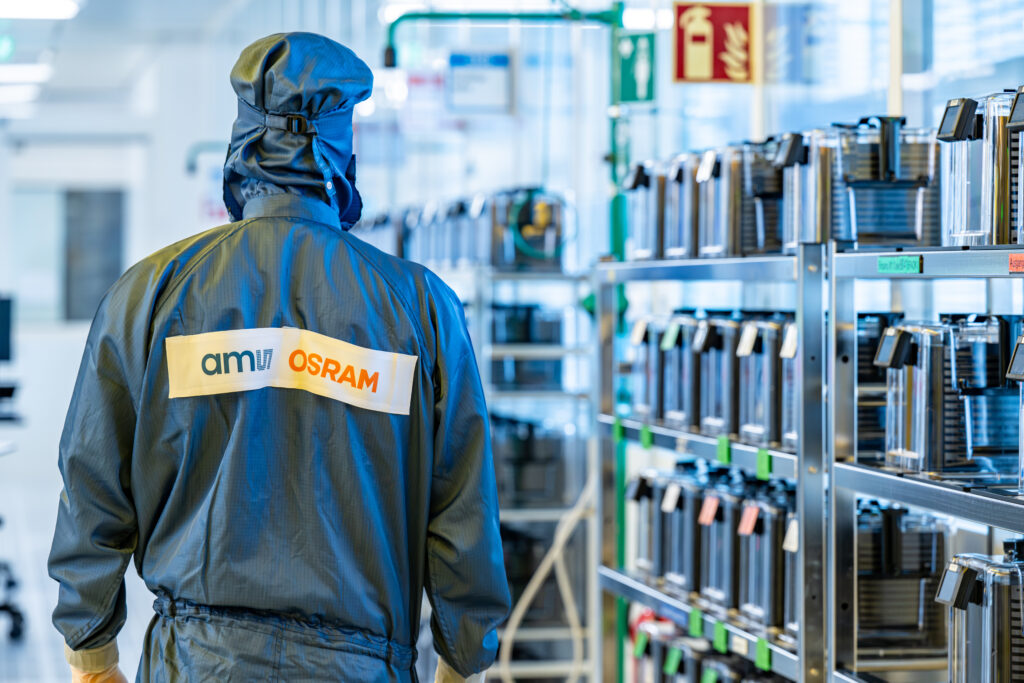
Planning in metal processing is heavily shaped by short-term changes. Production orders are derived from SAP/ERP. As a result, the planning horizon is short, because order conditions change too frequently beyond that point.
Missing raw material repeatedly becomes an operational bottleneck, leading to delivery delays, backlogs and a high coordination effort. The challenge is further increased by the fact that production planning must simultaneously take machine availability, setup states, shift schedules and employee qualifications into account. Not every machine can process every order, and not every employee can work on every machine.
In addition, automatic, semi-automatic and manual machines require different levels of personnel capacity. Multi-machine operation is possible, but not always practical. All of these dependencies intensify the central trade-off: reliably meeting delivery dates while achieving efficient machine and personnel utilization. This is exactly what makes realistic and robust production planning indispensable.
ams OSRAM expects a production planning approach that reliably reflects the real production situation and can respond quickly to changes. Delivery delays should be reduced, backlogs should be addressed more effectively without adding headcount, and existing machine and personnel capacities should be utilized more efficiently. At the same time, the plan must be understandable on the shopfloor, create acceptance and serve as a reliable basis for operational decision-making.
The workshop lays the foundation for subsequent production planning. Together with ams OSRAM, we examine the actual workflow in metal processing. The focus is on the real processes, resources, constraints and dependencies that shape planning in day-to-day operations.
In the next step, the relevant planning logics are developed jointly. These include process variants, raw material availability, machine capabilities, employee qualifications, shift models, setup states and delivery-related priorities. This creates transparency around the factors that actually determine planning in everyday operations.
A central part of the workshop is the translation of experience-based knowledge into a structured planning foundation. The knowledge of planners and production staff is systematically captured, jointly structured and translated into clear decision logics. At the same time, the team jointly defines what a good plan must achieve in an operational context. This includes delivery performance, utilization, a meaningful deployment of personnel and planning that is easy to understand.
The result is not a loose collection of individual requirements, but a documented planning foundation. It makes target conflicts transparent, creates a shared understanding of planning and forms the basis for the technical implementation with DeepSynergy.AI Production Planning.



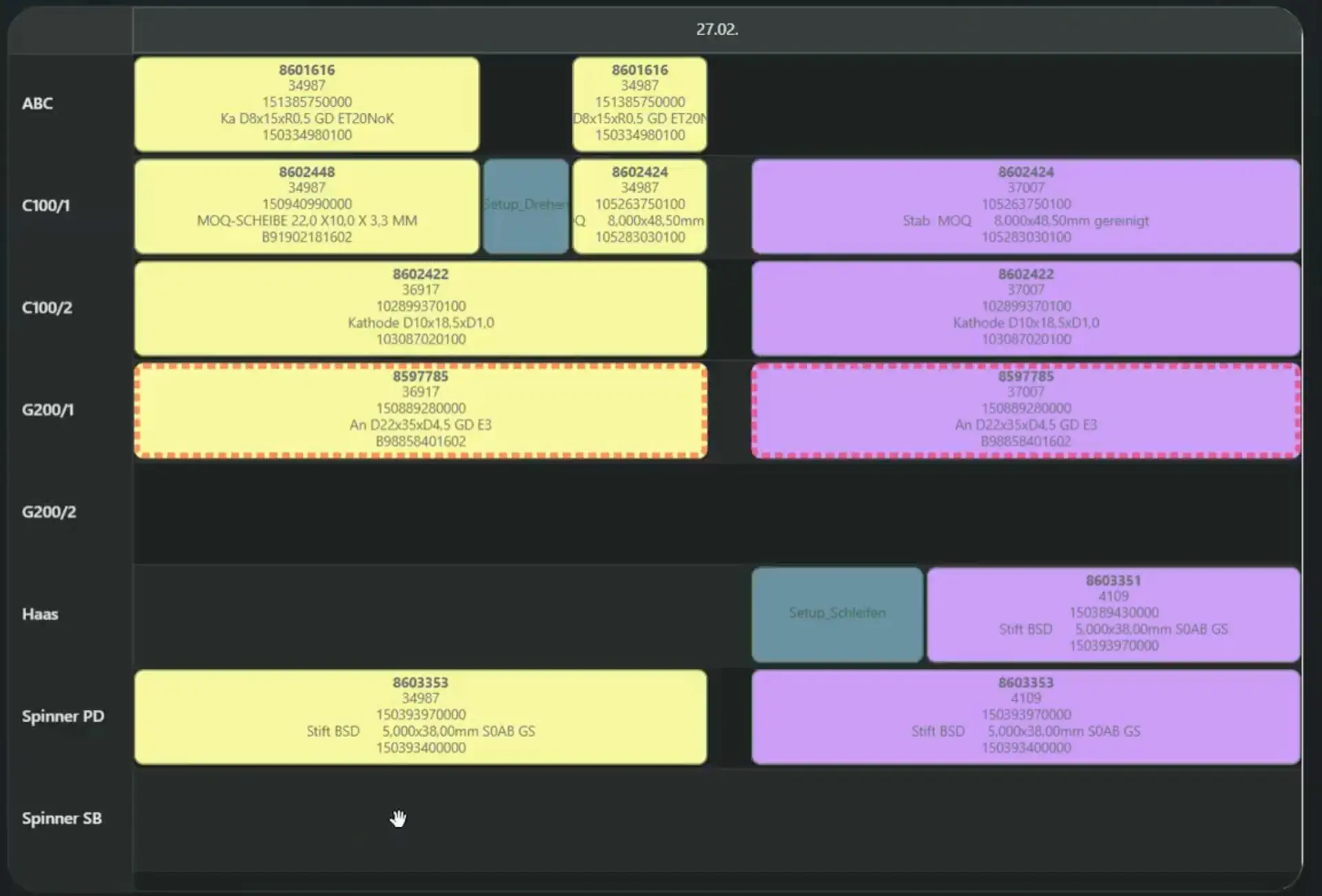
At ams OSRAM, DeepSynergy.AI supports production planning for turning and grinding. The solution brings together delivery dates, raw material, setup states, machine availability, shift schedules and qualifications in a single plan.
In the background, these influencing factors are incorporated into an individually weighted objective system. This results in a production plan that reflects the real production situation and is feasible in day-to-day operations.
Delivery dates remain the primary reference point in planning. Orders are prioritized so that delivery dates can be met more reliably. At the same time, the plan takes into account when the final process step must be completed at the latest in order for the order to be finished on time.
Orders are not scheduled in isolation. Planning considers which raw material is already available and which incoming material is expected in the coming days. This results in production plans that are realistically executable, rather than formal sequences with no material reference.
Setup states and changeovers directly influence both effort and sequence. The setup logic consistently reflects these effects and considers where similar materials, diameters or processing conditions can be grouped in a meaningful way. This makes planning more realistic and more stable.
Not every machine can process every order. Not every employee can work on every machine. Planning therefore directly considers machine capabilities, shift models, employee availability and qualifications in detailed scheduling. This results in a plan that is actually feasible on the shopfloor.
New orders, changing priorities or missing raw material do not trigger manual rescheduling. Based on the same planning logic, DeepSynergy.AI generates a new robust production plan within a short time. This keeps planning responsive even when order conditions change.




In day-to-day operations, what matters is not just a plan on paper, but measurable impact in execution. At ams OSRAM, production planning becomes more systematic, transparent and repeatable. Decisions are based on a consistent logic rather than short-term coordination. The result is a production plan that is accepted in production and can be adapted quickly when order conditions change.
1,000 additional productive hours per year
Machines and employees are scheduled more effectively. Idle time, unnecessary changeovers and coordination effort are reduced. This creates more time for productive work over the course of the year.
80% less planning effort
Planning decisions are prepared systematically. Manual coordination effort is significantly reduced. Fewer follow-up questions, less short-term rescheduling and clearer priorities noticeably ease the planning workload in day-to-day operations.
+10% improvement in on-time delivery
Delivery dates are given high priority in production planning. As a result, orders are completed more reliably by the required date.
More stable planning despite changes
New call-offs, data corrections or missing raw material do not immediately create disruption in operations. Planning remains reliable even when conditions change.
Increase productivity without adding headcount
Backlogs are worked off more efficiently. At the same time, machines and employees are aligned more effectively. This increases utilization without requiring additional headcount.
Greater transparency and acceptance in production
The plan shows which orders are scheduled on which machines and with which employees. This makes planning more transparent in production, improves acceptance and supports consistent execution.
Reliable foundation for further scaling
With KPI logic, feedback loops and a documented planning foundation, a basis is created on which additional processes and expansion stages can build.
Less firefighting, more room for strategic planning
Fewer short-term interventions create room for more forward-looking planning. This allows greater focus on priorities, capacities and operational goals.
At ams OSRAM, production planning does not simply sort orders. It evaluates whether an order is actually ready to start under real conditions, how process steps relate to one another over time, which sequence reduces setup effort, and which resources are truly available on the shopfloor. This results in a production plan that jointly considers delivery performance, productivity and operational feasibility.
A production order may formally exist and be relevant from a scheduling perspective. However, this alone is not sufficient for detailed scheduling. The key question is whether the required raw material is actually available or will become available shortly. At ams OSRAM, different raw material groups exist. Two of them are always available, while others must be actively considered. A process can already start when 95% of the required raw material is available. This is why DeepSynergy.AI evaluates not only orders and dates, but the actual start feasibility based on material logic.
At ams OSRAM, delivery logic does not end with the delivery date itself. What matters is that the final relevant process step must be completed no later than 48 hours before the delivery date. For Monday delivery dates, the lead time is even 72 hours. At the same time, detailed scheduling includes different process variants depending on the order, such as turning only, grinding only, or a combination of both. This turns an end date into an operational lead-time rule that directly affects sequencing.
At ams OSRAM, setup times are not fixed, but depend on the machine, the material and the sequence of orders. If the same material number is processed again, setup effort is reduced significantly. With other changes, it increases noticeably. The grinding machine also follows its own setup logics. This is why sequencing is not only a question of delivery dates, but also an economic decision. By grouping similar orders in a meaningful way, planning becomes more stable and effort is reduced.
Within the scope considered, multiple machines with different degrees of automation are planned simultaneously. These resources do not require the same level of personnel capacity in every case. The planning logic therefore distinguishes between automated, semi-automated and manual machines. Automated machines generally require less personnel capacity, while manual machines require more. At the same time, not every employee can operate or set up every machine. In addition, the characteristics of individual machines are also taken into account. For example, an automated machine may be more prone to failure due to its age and more difficult to maintain because spare parts are harder to obtain. In such cases, the objective system weighs whether using that machine is truly necessary in order to contribute positively to the higher-level goals. Production planning must therefore consider machine availability, degree of automation, shift model, qualification matrix and machine characteristics together. Only then does a plan emerge that is truly feasible in production.
At ams OSRAM, production planning operates within a clear trade-off. On the one hand, delivery dates must be met and backlogs reduced. On the other hand, machines should be utilized productively and personnel resources deployed effectively. This trade-off is further shaped by the fact that automated machines require less personnel capacity than manual ones, and that individual machines are not always equally attractive for use despite their technical advantages. DeepSynergy.AI translates these competing requirements into an individually weighted objective system. The result is not one-dimensional optimization, but a robust planning logic for day-to-day operations.


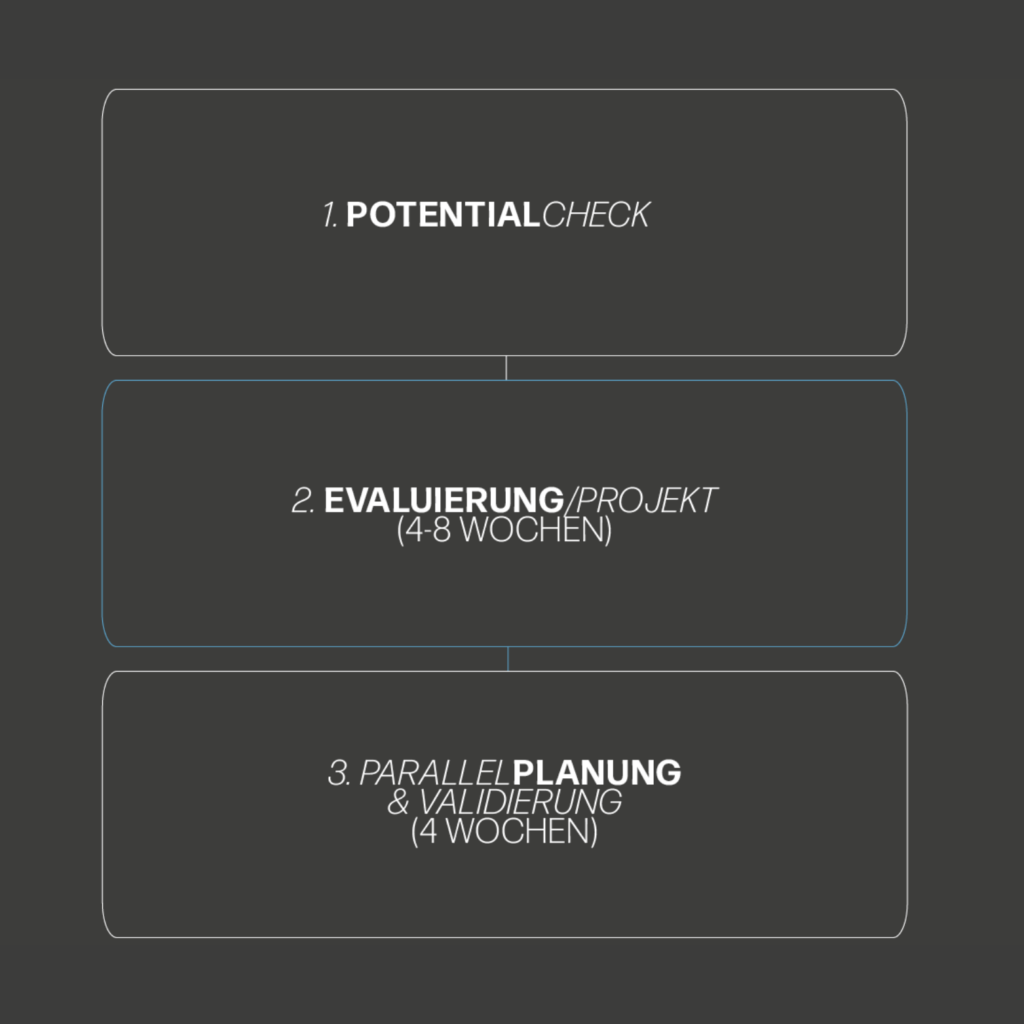
1. Potential analysis
The project starts with a joint potential analysis. The focus is on the current planning situation, the operational bottlenecks and the relevant trade-offs in the turning shop. At the same time, the scope is clearly defined. This creates a shared understanding of which processes, resources and constraints must be considered in detailed scheduling and what potential can be unlocked in planning with DeepSynergy.AI.
2. Parallel planning
On this basis, detailed scheduling is built for the defined scope. In joint workshops and based on the available data, the relevant planning logics are modeled. These include, among other things, raw material availability, process variants, setup states, machine capabilities, employee availability and qualifications. This results in an initial production plan with DeepSynergy.AI, which is evaluated in parallel operation and refined further through targeted feedback loops.
3. Validation
In the final step, the results are validated in parallel operation. This involves comparing key KPIs of the previous planning approach with the results of planning with DeepSynergy.AI. In addition, feedback from the shopfloor is incorporated. This creates a reliable basis for assessing impact, operational feasibility and the next steps transparently.
Whether in production, logistics or other planning challenges
– DeepSynergy.AI is your partner for complex solutions

Unlock your full efficiency potential with AI‑driven production planning.
Benefit from bespoke consulting that delivers automated, ultra‑optimized schedules precisely tailored to your processes.
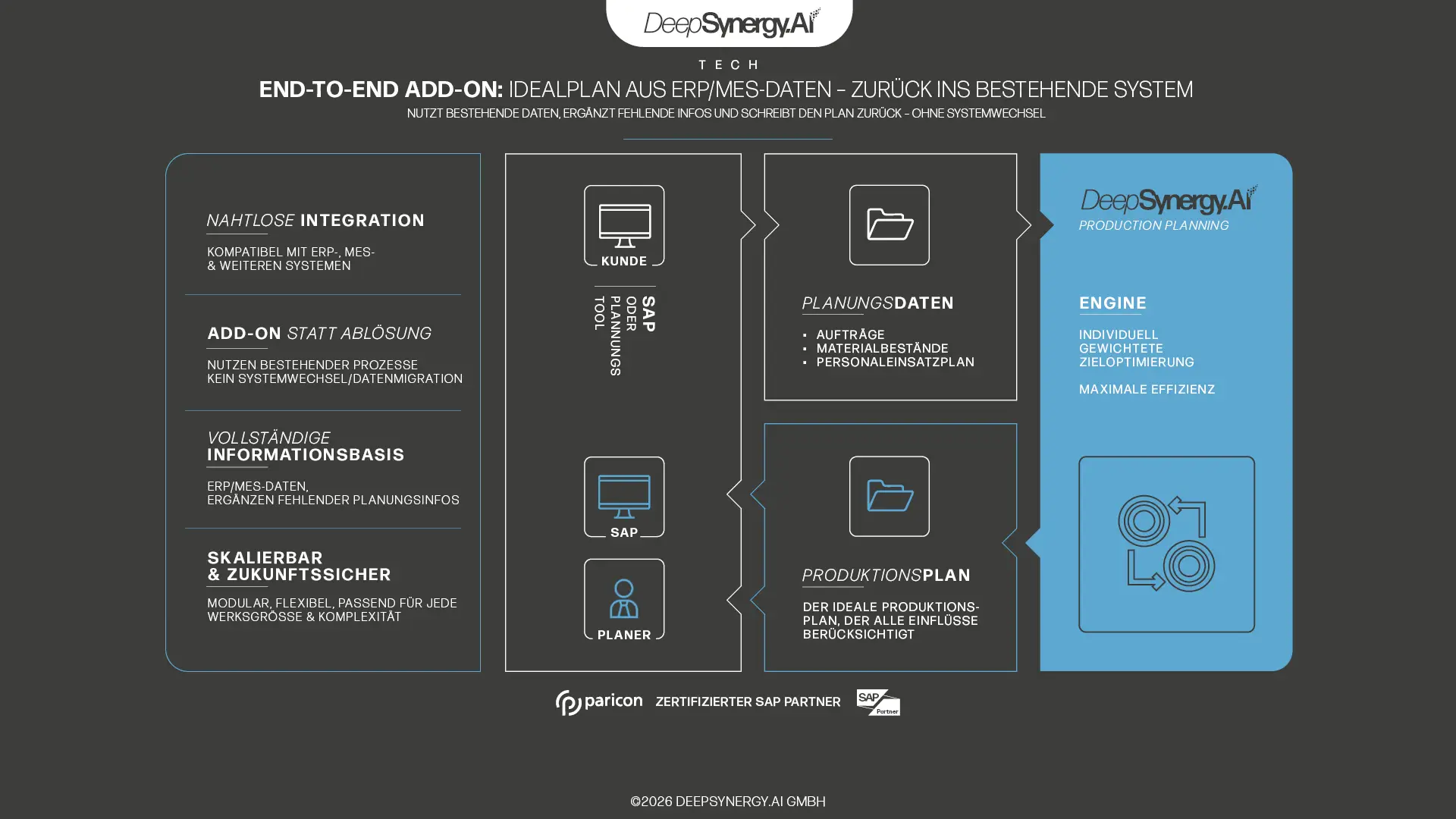
Nutzen Sie jetzt Ihre Effizienzpotenziale – mit KI-basierter Produktionsplanung Individuelle Beratung für eine automatisierte, hochoptimierte Produktionsplanung – auf Ihre Prozesse zugeschnitten.
Nutzen Sie jetzt Ihre Effizienzpotenziale durch KI-basierte Produktionsplanung.
Individuelle Beratung für eine vollautomatisierte, hochoptimierte Produktionsplanung, auf Ihre Prozesse zugeschnitten.
Unlock your full efficiency potential with AI‑driven production planning.
Benefit from bespoke consulting that delivers automated, ultra‑optimized schedules precisely tailored to your processes.